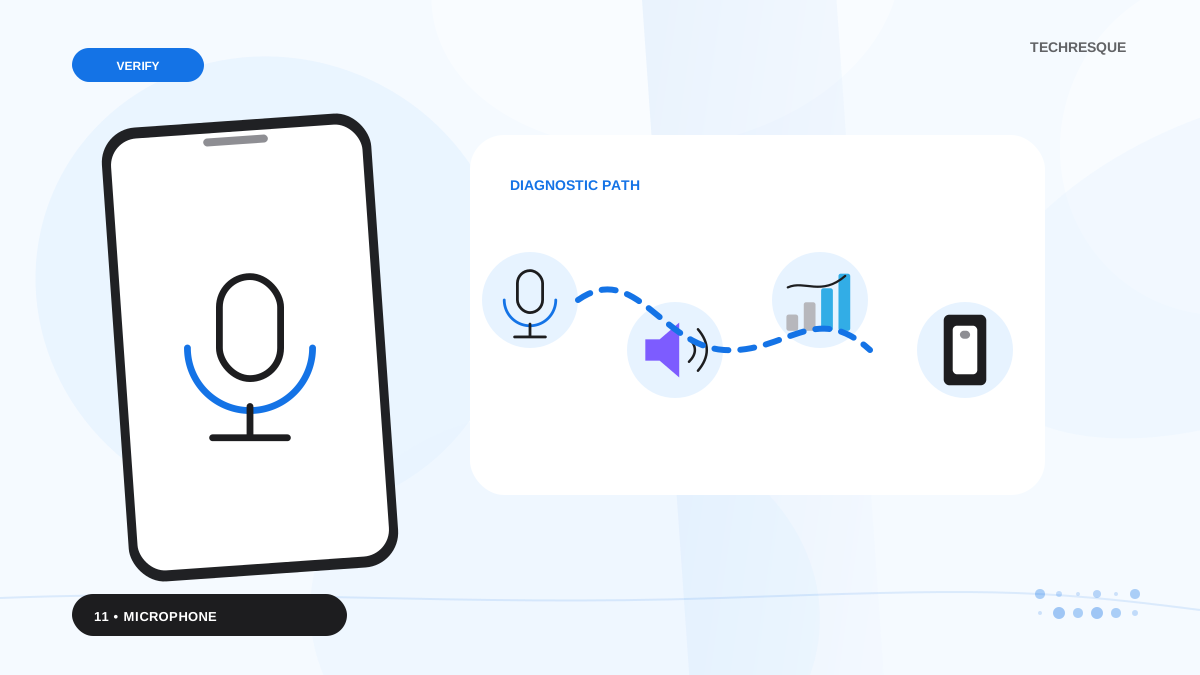
Go to Settings → Privacy & security → Microphone and allow access, then Settings → System → Sound and select/test the correct input device before touching drivers.
Start with the simplest reversible checks before moving to resets or repair.
Why this happens
Do not assume the most expensive failure first. This problem usually becomes much easier once you separate a settings problem from a connection, app, accessory or hardware problem.
- Microphone access is disabled globally or for the app.
- The wrong microphone is selected as the default input.
- A physical mute switch or headset control is active.
- Input volume is set very low.
- The audio driver is missing, damaged or incompatible after an update.
Fix it in this order
- Check the headset or microphone for a physical mute switch.
- Open Settings → Privacy & security → Microphone and turn on Microphone access.
- Allow apps and desktop apps to access the microphone as needed.
- Open Settings → System → Sound and select the correct device under Input.
- Use Windows' input test and adjust input volume.
- Restart the affected call/app and the PC.
- If Windows does not detect the microphone at all, update or reinstall the audio driver through Device Manager.
How to identify the real cause
If the Windows input meter reacts when you speak, the hardware and basic driver path are working; the problem is likely inside the specific app. If the device is absent from Sound settings and Device Manager, focus on connection, hardware and drivers.
Common mistakes that waste time
- Reinstalling drivers before checking privacy permissions.
- Testing in only one app.
- Forgetting a hardware mute button on the headset or laptop.
- Setting microphone boost extremely high and creating noise instead of fixing detection.
Why the troubleshooting order matters
Good troubleshooting changes one variable at a time. Start with the checks that are fast, reversible and low risk. If the problem disappears after one change, stop there and verify it for a while instead of continuing to reset unrelated settings.
Also pay attention to scope. A problem affecting one app or one accessory usually deserves app/accessory troubleshooting. A problem affecting everything on the device points more toward a system setting, network, driver or hardware issue.
When this is probably not a settings problem
Test the microphone on another computer. If it fails there too, suspect hardware. If several microphones fail only on this PC, focus on Windows audio/USB hardware and drivers.
If you need repair or manufacturer support, write down what you already tested. A short list of known-good cables, devices, networks or apps you tried is much more useful than saying only that the feature “doesn't work.”
Test at three layers
First test the microphone in Windows Sound settings. Then test it in a simple recorder. Finally test the target app. If it works at the first two layers but fails in the third, stop reinstalling drivers — the remaining problem is almost certainly app selection or permission.
USB microphones need a direct test
For USB microphones, bypass docks and front-panel hubs during diagnosis. Connect directly to the PC, wait for Windows to enumerate the device and select it explicitly under Input. Once it works, reconnect your normal hub to see whether the issue returns.
Once one step appears to work, stop and reproduce the original problem under the same conditions. If it stays fixed, leave unrelated settings alone. That preserves a clear cause-and-effect trail and avoids creating a second problem while trying to solve the first.
If the symptom returns, write down the trigger, time, network, battery level, connected accessories and app in use. Those details make the next diagnostic step much more precise and are useful if you eventually need manufacturer or developer support.
Frequently asked questions
Why did my microphone stop working after a Windows update?
Permissions or drivers can change after updates. Microsoft specifically recommends checking app access and drivers.
How do I know Windows can hear me?
Use the input test under Settings → System → Sound.
Why does the mic work in Windows but not in one app?
That app may have its own selected input or permission setting.
Should I uninstall the audio driver?
Only after basic connection, permissions and input-selection checks fail.
Official sources used
- Microsoft Support — Fix microphone problems
- Microsoft Support — Fix sound or audio problems in Windows
Techresque uses manufacturer documentation as the primary factual source for these troubleshooting guides. Menu names can vary by model, Android skin, iOS version or Windows build.